Posts

Showing posts with the label leadership

Managing top-down messages

Image
As a leader, there are times when you’ll need to communicate messages which you receive from above, down to your team. Sometimes these will be messages which you support, and sometimes you might not. It’s important to remember that you’re not there to openly disagree with the message, but to communicate the message onwards in a way which helps people to accept what’s been said. In order to be sincere when you communicate your message, you need to ensure that you have all the information you need from above. If you have to keep going back and checking things, it undermines your own belief in the message, and weakens the impact of your communication. Here are some questions you can ask yourself to ensure you have the full information… What’s the topic? What timescale does it relate to? Which areas of the business does it impact? What flexibility do I have when communicating it? What should I do if it’s badly received? What suppo...


Resolving conflict using Nonviolent Communication

Image
Using Nonviolent Communication to defuse conflict Nonviolent Communication was developed in the 1970s by Marshall Rosenberg as a way to get beyond the typical elements of conflict, and to encourage empathy by both parties. It requires you to adopt the mindset that the other person isn’t trying to annoy you on purpose, and then works to overcome differences and expand understanding of each other. It works like this: Observation: A neutral statement of what’s going on. “When you give me a large piece of work at 4 o’clock on a Friday…” Feelings: An accurate statement of how you feel. Avoid saying “you make me feel” and concentrate on the feelings themselves. “I feel stressed because I want to do a good job, and concerned that I’ll miss a personal appointment after work.” Needs: A statement of your internal needs. Avoid phrases which begin with “I need you to… (XYZ)”. “I need to know that I can deliver work to my usual high quality, and that I will be able to see my friends after work. ” ...

Recognising and resolving conflict

Image
There are many definitions of “conflict” in the business world. It’s important to remember that conflict isn’t always visible. Some people might be “in conflict” with others, but instead of raising their voices and arguing, they withdraw inside themselves and go quiet. I like the following definition of conflict: Conflict is when someone is forced by someone else to operate in a way which makes them uncomfortable. If you take this definition, then the topic captures quite a wide range of situations. How does conflict start? Conflict comes about when an event happens which makes someone uncomfortable, and when it then spirals unchecked into a breakdown in the relationship. It goes through 4 steps: Situation: Something happens. One person does something the other person doesn’t like. Example:     Your manager gives you a big piece of work at 3pm on a Friday and tell...

Improving internal relationships

Image
As a leader, there are a number of internal relationships you should be aware of. It’s not just relationships with your team and your boss which are important – you now have impact and input across other teams and the organisation as a whole. Here’s an image to illustrate: Although to begin with, some of these relationships might be challenging or outside of your comfort zone, it's important to work on your skills to build these relationships to increase your confidence and the way you’re perceived in the organisation. Rights & responsibilities As you grow in your relationships with others in the organisation, it’s important to remember that you have rights in any working relationship, and also responsibilities. And, of course, the other person also has their own rights and responsibilities. If you find a relationship challenging, then it’s worth remember the rights that you have. These are things like: The right to be treated with respect. The right...

Motivating your team

Image
Although people are motivated by different things, there are 4 which apply to most people, although different people will attach different importance to these. Daniel Pink explains it as follows: Autonomy: People are happy to be given a goal, but would prefer to work towards it in their own way rather than being micro-managed. Mastery: People want the opportunity to become an expert at something, and to have that expertise recognised by others. Purpose: People want to understand the point behind their work, and what higher purpose they are contributing to. I also think money is in the mix as well. People need enough money to live a reasonable lifestyle. They might have different financial needs at different points in their life. As a leader, you need to motivate your team members. Although people have individual motivational needs, they are likely to respond to these generalisations. Good practice is to ask people what motivates them. Some leaders are uncomfortable asking that as t...

Understanding where problems (and opportunities) have come from

Image
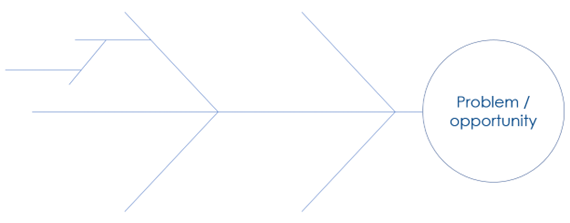
If you can understand the conditions which caused a problem to develop or an opportunity to come along, then you’ll be able to think about how you can replicate those conditions (for opportunities), or change them (for problems). For example, if you realise that an opportunity presented itself which you were only able to take advantage of because of your proactive recruitment strategy, you’ll want to continue that strategy in the future. 5 Whys The 5 Whys technique encourages you to look not at superficial causes, but to look deeper for root causes. For example, imagine you’re waiting for a train and an announcement comes over the loudspeaker saying: “Your train is delayed due to the late arrival of a preceding service.” You likely find this frustrating because it’s not a real reason for the delay – you want to know why the preceding service was running late. The idea with 5 Whys is that you keep asking “why?” until it feels like a daft question. This is likely to be around 5 times. Th...

Critical thinking - scanning the environment

Image
The first place to look for opportunities and problems is within the organisation. For this, you can use a STACK analysis to get a good understanding of the current situation in the business. Strategy Tolerance for risk & change Available resources Configuration Knowledge & skills A STACK analysis helps us to do a few things: Get a good understanding of the current state of the organisation and its readiness to implement change Understand how well-aligned the organisation is from the top, where strategy is developed, down to individual contributors Consider whether there are sufficient resources to take actions you need Identify whether the way the organisation is set up would be helpful to grasping opportunities or addressing problems Understand whether additional expertise might need to be brought in from outside. Once you’ve understood the internal situation in the organisation, it’s time to look at whats going on externally which could affect your strategy. For this...

Why you need to think critically as a leader

Image
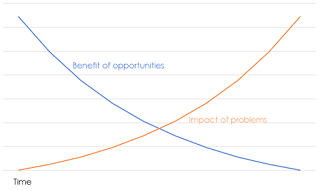
Remember, the internal and external environments are constantly changing. The organisations which react best to these changing circumstances are the organisations who will thrive whatever the conditions. It’s important to remember certain characteristics which connect opportunities and problems with time: the longer you leave them unaddressed, the benefit of advantages decreases, and the impact of problems increases. What this means, is that to take advantage of any situation in the work environment, speed is of the essence – you need to spot opportunities and problems more quickly, and take action once you’ve identified them.

Working strategically with your team

Image
I’ve talked in the past about having a vision for your team – this describes where you want the team to be at a set point in the future, and should guide all decisions you make with and about your team. This team vision fits into a wider strategic approach to running your team – you need a strategy for what the team will achieve, and you also need to ensure that the team strategy is aligned with strategies above you in the organisation. Organisational strategy works something like this…   There’s an organisational strategy set from the top. There are then X number of divisional strategies which feed down from this. The sum of all the divisional strategies should achieve the organisational strategy. The next level down is team strategies, and even within your team, you could have functional strategies: the individual tasks and KPIs for each team member. A solid organisational approach to strategy means that all the lowest level parts, when combined, achieve the organisational strate...

Using the right persona in the right situation

Image
Here's a follow-on from last week's post about the 3 leadership personas ... Now that you understand the 3 critical personas, it’s up to you to decide when you should be using each to get the best performance from your team. There are different requirements of your employees as they go through their working week. Taking a sales team as an example, they might sometimes need help to plan strategically, or advice on how to spot opportunities and problems for their clients in order to open up sales opportunities. Sometimes they might need to be coached on how to approach a sales call or meeting, and will need feedback afterwards. And other times they’ll need you to step in directly to share your own sales experience to help them close a deal. Over time, you should look to reduce the amount of time you spend being the expert and increase the time you spend being a manager and a leader. Try to aim for a 40/40/20 split between leader, manager and expert. If you can ach...

The 3 personas of a leader

Image
If you've been a leader for at least a few months, you’re probably beginning to notice a few things about your “new normal”. These might include: •    There are different facets of your role •    You need to use a different approach in different situations at work •    You still do your “day job” •    You feel that you have more to do, but no extra time to do it in. But that’s life…! Now you’ve recognised these things, it’s time to start thinking about the different elements of your role (I like to call them “personas”), which to employ each, and what that looks like. Persona 1: Leader Being a leader is about setting the vision for your team. It’s about know where you are as a group and where you want to get to. It’s also about thinking about what needs to happen to achieve that. This is about knowing your vision and making sure every decision you make supports that vision. It’s the leader who thinks about setting motivational ...

Developing your own skills as a leader

Image
As a leader, you often don't benefit from the same level as support as your team do. For that reason, you need to be a little more self-sufficient about developing your own skills. Here are some ideas to help you do that... There are 2 topics in this article: Asking for feedback Proactively developing new skills How to ask for feedback Most people would agree, that when it’s delivered well and fairly, feedback is incredibly helpful. Our definition of feedback at Navanter is: Shining a light on something, positive or negative, that the other person isn’t aware of, and the impact their actions is having on their work. If you take this definition, then you should always want feedback, because it stops you doing things which make you look bad, and it gets you the appreciation and recognition you deserve when you do something well. Feedback is also just one person’s view on something, and not necessarily a balanced assessment of your performance. To ask for feedback (and use it), you sh...

Making decisions

Image
Here's the next part of our series on leadership skills... There's an ongoing trend in organisations at the moment for decisions do be made further down the organisation where appropriate. As a leader, you’re going to need to take decisions, either alone or with others, so you’ll need to techniques in this section to ensure your decision is a strong one. The Impact-Ability matrix This is a particularly helpful tool to take the subjectiveness out of making decisions. It helps you to take an unbiased view by considering two elements: The impact your chosen path will have on the team, organisation or problem. How easy it will be to action the decision once made. The matrix is a simple 4-box grid: You plot your options on the grid according to the two axes, then you select the option(s) nearest to the top-right corner as your “good ideas” to take forward. Identifying risks So you’ve made your decision… except you haven’t tested it at all to check for problems. A major consideration...

Running an engaging team meeting

Image
Running an engaging meeting Unfortunately, if you ask most people in any organisation, they’ll likely tell you that they attend too many meetings. The first key element in an engaging meeting is knowing what the meeting needs to achieve. If you don’t spell this out, then the meeting lacks direction, drags on too long, and people don’t see the point in being there. Desired Outcome Statement A Desired Outcome Statement is a short, SMART (Specific, Measurable, Agreed-upon, Realistic, Time-constrained) statement which shows you what you want to happen at the end of your meeting. An example could be: By the end of this meeting, we will have an agreement on the current status of our sales, and five actions to give sales a boost. Having a statement of this sort in place at the beginning of planning for your meeting enables you to build the entire event with this in mind, including: Setting the topic Inviting the right people Engaging the right people in advance Considering th...

The importance of personality in leadership

Image
As you maximise your ability to communicate with your team members, it’s important to understand not just your strengths and what you bring to the role which are important, but also who you are as a person. How do you tend to communicate? What impact might that have on others? Where and how do you like to operate? The Greek philosopher, Hippocrates (460-370 BC), was the first person to record the different personality styles which he observed in the world around him. He gave them different names in those days (it was over 2,000 years ago – fashions change) but his observations were startlingly correct, and are still used today in many personality assessments. Hippocrates called the four types: ·         Choleric ·         Sanguine ·         Phlegmatic ·         Melancholic His work was re-visited by more modern philosophers such ...

Breaking down silos

Image
If you’ve been effectively following the principles outlined so far in this series, then you’ll automatically be making progress in breaking down silos which exist. You can now bring this all together into thinking about the relationships you have across the organisation to improve communication and collaboration. Understanding where your team fits in In order to widen your professional network within the organisation, you need to think about the people you rely on and the people who rely on you. This creates a very simple workflow to use as a basis for building your internal professional network. As you complete this diagram, you need to think about: •    Who your team relies on •    What your team does •    Who relies on your team •    Who the key stakeholders are on each side of the map Once you understand this information, you can think about who would be the most suitable people to have in your internal network. What i...

Creating a Team Charter

Image
If you've been following this series of posts, you now have your clear vision for the team. That means that you can now work to make your team gel by developing a team identity around this vision, and the way the individuals in the team would like to operate. A key element of this is the development of a Team Charter – this is a document, created by the team members together, which maps out how the team will operate. It brings a number of advantages: Team members feel “bought in” to the success of the team Greater adherence to “rules” as everyone has had input into their development Mindset that it’s “our” team, rather than “the leader’s team” Team charters are flexible documents which should be reviewed annually, or whenever there’s a major change in the team’s make-up, such as new members joining. The elements of a team charter Whilst there’s no set way to create a team charter, there are some areas which are useful to consider when developing this agreement. These include: Why ...

Your vision for your team

Image
In a previous blog post, I reminded you of the important skills you have as a leader . Now it’s time to think about the team and the impact you’d like them to have. You need to think about which other parts of the organisation benefit from what your team does. Consider the value you bring. Put yourself in the shoes of these other parts of the organisation, and ask yourself. "In an ideal world, what additional value would these parts of the organisation want to gain from the people I manage?" This should become your over-arching goal for the team. It’s about bringing value to the organisation, either directly, or in collaboration with others in the business. Then, consider what it would mean if you achieved this additional value, for you, for your team, and for the organisation. Your vision statement is a sentence which describes this desired future state, written from the perspective of it being a goal for you: "By [date], we will be [what you’ll be doing] in order to [v...

Overcoming self-limiting beliefs

Image
 In this week's tip, we'll look at how to recognise and overcome self-limiting beliefs as a leader. Before you work on your team vision, it’s important to remind yourself of what you’re capable of, and to remove any self-limiting beliefs. A self-limiting belief is a belief you have about yourself which puts an artificial ceiling on what you can achieve, by draining your own self-confidence in your role. Self-limiting beliefs can come from many places, such as: Past experiences Comments by others Values we inherit The media & social media The way we compare ourselves to others Breaking d...