Posts

Showing posts with the label creativity

Why you need to think critically as a leader
Image
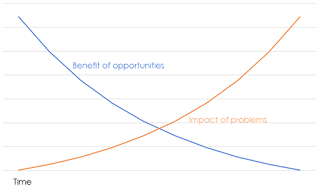
Remember, the internal and external environments are constantly changing. The organisations which react best to these changing circumstances are the organisations who will thrive whatever the conditions. It’s important to remember certain characteristics which connect opportunities and problems with time: the longer you leave them unaddressed, the benefit of advantages decreases, and the impact of problems increases. What this means, is that to take advantage of any situation in the work environment, speed is of the essence – you need to spot opportunities and problems more quickly, and take action once you’ve identified them.

The fourth building block of a culture of creativity and innovation

Image
I promised you 3 building blocks, but counting never was my strong point, and anyone who's had one too many on a 3-legged bar stool will know that the 4 legs of a chair are safer! My last strategy for you isn’t about creativity as such - it's about ensuring that all the blue sky thinking doesn't bring about some crackpot idea which will sink your organisation. And that's pretty important, isn't it?! By the way, if you’ve not seen the previous 3 posts, do take a look at: Part 1 Part 2 Part 3 You see, if there's 1 barrier to creative thinking in organisations, it's usually from above (you might remember that from yesterday's email) and it's a fear that something new will cause unforseen problems. Whatever ideas your team come up with, they'll most likely need to "sell the dream" to senior management - or perhaps to you! After all your innovative thinking exercises are finished, you could well have a large number of ideas....

The third building block of a creativity culture

Image
As we reach part 3 of our building blocks of a creativity culture, what have we looked at so far? We've looked at 2 building blocks of a creativity culture:     Encouraging a creativity mindset     Creating the right forum for ideas to come forward I often use an antique camera to encourage creativity (you'll have to come on one of my workshops to learn that one), and as any photographer knows, tripods have 3 legs for a reason: they're just not stable on 2. So my 3rd building block of a creative culture is the tools themselves, and these are vital to enable people to thrive in the environment you've created with the first 2 steps. As people, we have a problem with innovative thinking - we're not very good at it. As children, we're brilliant at this - I see this with envy when I look at my 5 year old. But then we go to school, where we're told that there are right answers and wrong answers. Then we might go to university, where we're told more of the sam...

The second building block of a creativity culture

Image
If you saw last week's post , I hope you’ve got some ideas to influence your team's creativity mindset from the tips in there. Here’s #2 of my 3 building blocks of a creative culture. Too many leaders think that if they ask people to be more creative, it'll just happen. Or they think that getting a group of people into a meeting room together with a whiteboard is the silver bullet to generate innovative ideas. And they're inevitably disappointed when that doesn't work. The problem is, that might work for some people, but it doesn't for everyone. Traditional brainstorming sessions can get dominated by those with stronger personalities. Those who prefer not to be the centre of attention will not take part, and the ideas of those people are never captured. And in the virtual world, it's even easier for people to hide.   Creating the right forum for ideas to flow However, there are some really simple yet effective techniques to ensure not on...

3 building blocks of a creativity culture

Image
If you're looking to create a culture of creativity, I like to think of 3 vital building blocks as a foundation of your success.  Here's #1 of my 3 building blocks of creativity, and it's around fostering the right mindset in employees. Because, you see, it's so easy, in our busy world, to "teach" people the wrong behaviours. What do I mean by that? Well, imagine you're in the office (or the virtual office), having a really busy day. You have a to-do list as long as your arm, and someone comes up to you to ask you something.      Excuse me Neil, how should I... (whatever the problem is)? What do you do? You look at your watch, look at your to-do list, and then give the person the answer to their question. You probably give that answer pretty comprehensively, because you really don't want them disturbing you again 5 minutes later. But there's a problem here - you've just taught that person something. And it's not just the answer to their que...